
LinkedIn outreach that works: the honest playbook
Everything we've learned running LinkedIn prospecting for dozens of B2B companies, in one page: why most outreach fails, the real numbers we measure across dozens of B2B fleets, the messages that actually get replies — and the four-step system behind them, which you can run by hand or hand off entirely.
You've probably seen the "I booked 800 leads in a week with AI" posts. Most of them are nonsense. What follows is what our data actually shows — written so you can use it whether you ever pay us or not.

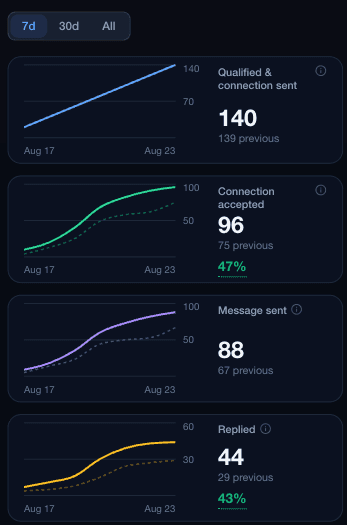
Where this playbook lands when it runs on autopilot: connections, messages and replies compounding every day, in one dashboard.
First, why most LinkedIn outreach fails
Volume isn't the problem. Relevance is.
The default playbook is to blast a generic pitch at as many people as possible. It's why your inbox is full of messages you ignore — and why, when you do it, you get the same silence back. "I sent 200 messages this month, maybe 3 replied" isn't a you problem. It's a method problem.
Spray-and-pray
- Generic message to a bought list
- Pitch in the first line
- People are defensive from word one
- You need ~100 messages to start one real conversation
Relevant outreach
- The right person, reached at the right moment
- A message about them, not you
- Feels like joining a conversation they started
- A handful of messages starts a real one
Good prospecting is two things: good targeting and good points of contact, done consistently. That's the whole method. Everything below is just how to do those things well — and how to make them run without you.
What the data says
We measure everything. These are the real numbers.
We run LinkedIn outreach for dozens of B2B companies and measure every step of every funnel. Everything on this page comes from that data, not from outreach folklore. A few of the findings:
Your headline is the invite
15% → 26% accept, same engine
Same sources, same messages: accept rates still spread from 15% to 26% across accounts — and the remaining variable is the profile. A sales title in your headline tells buyers "you're about to be pitched." Rewrite it to read like a peer, not a rep.
Precision isn't free
28% vs 19% accept — at half the volume
Very narrow targeting accepts better — but runs at half the daily volume, and the widest accounts hold the most weekly conversations. Narrowing your ICP is a real trade, not a free upgrade. Decide with both sides in view.
Warm beats perfect
55% vs 16% accept
People engaging with posts in your market accept at 55% even when their firmographics look imperfect; perfect-on-paper database contacts accept at 16%. Qualification and acceptance pull in opposite directions — source on live signals first.
Curious how your current numbers compare to these benchmarks? Bring them to a demo.
Book a demoSteal this
What a message that gets a reply looks like
Here's the difference in practice. Same prospect, two openers: one ignored, one answered. (Real examples are anonymized.)
❌ The one that gets ignored
Hi [Name], I help businesses like yours grow revenue with our proven solutions. Would love to connect and explore potential synergies! Let me know if you're open to a quick call this week.
✓ The one that gets answered
Hi [Name], saw your post on [specific thing they wrote about]. Most [their type of firm] I talk to hit the same wall. How are you handling [specific problem] right now?
↳ Their reply
Honestly? It's a mess right now. What have you seen work for others?
The cheat sheet
- Relevance beats volume. One message referencing something real about them > 100 generic ones.
- Lead with them, not you. No pitch in message one. Earn the second message first.
- Ask one easy question. Make replying take five seconds.
- Sound like a person texting: short, no buzzwords, no “synergies,” no exclamation-mark sales energy.
- Follow up 2 to 4 times, spaced out, each with a new angle. Most replies arrive after the first message, not on it.
- Be consistent. A small number of good messages every single day beats a big batch once a month.
The honest catch: doing this by hand well takes a few focused hours a day, every day. That's exactly the part we automate.
Want these principles applied to your exact ICP? We'll walk you through it on a call.
Book a demoThe method: the always-on funnel
Four steps. Run them by hand, or let the ninja run them.
The principles and the numbers above condense into four steps. Each one is something you could do manually (it would cost you a few hours a day). Under each: what it looks like inside The Sales Ninja when it does the step for you instead.
Define exactly who you're after
Most outreach misfires because the target is fuzzy. Get specific: the role, the kind of company, and the situation. Not "marketing people," but "Heads of Marketing at 20–200-person B2B SaaS companies that recently raised." Write down what makes someone a yesvs. a near-miss; that's your qualification filter.
Your ideal client, structured — from your website, confirmed by you.
Find the people who are warm right now
A name on a list is cold. A name showing a signal is warm. Look for people acting in your market today: posting on your topic, engaging with competitors, hiring for the role your offer replaces. Reaching out then feels like joining a conversation, not interrupting one.
A sample from the first scan
- MRPosted about outbound this week
Founder · Northbeam IT Group
- ACEngages with a competitor's ads
VP Sales · Vantura Systems
- JOHiring an Account Executive
Managing Director · Clearline MSP
- SBCommented on a peer's post
CEO · Helm & Harbor Agency
- DKHiring their first SDR
Head of Growth · Fabrikline
Qualified prospects from the first scan — each with the signal that surfaced them.
Open with a message about them, not a pitch
The first message has one job: start a conversation. Reference something real and specific (a post, their role, their company), lead with them, ask one easy question, and keep it short enough to read in a glance. No pitch, no buzzwords, no "exploring synergies." If it reads like a brochure, it gets ignored.
Marcus Reed
Founder · Northbeam IT Group
Hi Marcus, saw your post about running delivery and chasing new clients at the same time. Most IT services founders I talk to are stuck in that exact spot. Is new business still mostly referrals for you?
A message written for one prospect, ready to approve — or set to autopilot.
Be relentless, stay human, know when to step in
Most replies don't come from message one. They come from a thoughtful follow-up days later. So you need a multi-step sequence, sent consistently, every day, without forgetting anyone. And when someone replies, speed and a human touch matter. The hard part isn't the first message; it's doing this every day, forever.
Open with something specific about them, then one easy question. No pitch, no meeting ask.
autoOne new concrete angle — or a genuinely free resource. Still no meeting ask.
autoOne concrete question and an easy out — the only message allowed to suggest a call.
reviewYour multi-step follow-up, running on a schedule.
Don't want to run four steps every day? That's the point: the ninja does. A new funnel launches in ~10 minutes.
Book a demoThe shift
Nobody likes prospecting. But everyone has something great to offer.
For too long, the loudest talkers and the biggest budgets have beaten the real experts: the builders, the operators, the teams who'd rather do the work than perform it. We built The Sales Ninja because we were those people. We had something good to sell and were drained by the selling part.
A ninja is the opposite of the loud salesperson: quiet, precise, relentless. It listens before it strikes. It starts from the prospect's need, not the seller's pitch. Stop treating LinkedIn as a place you have to perform. Start treating it as a quiet machine that brings you the right conversations while you do what you're great at.
Start today
Launch your LinkedIn funnel in 10 minutes. Let it run.
No third-party tools, no per-lead fees. Describe your ideal client, connect your LinkedIn, approve the strategy — then it compounds as the agent learns your voice and your market.
Prefer to explore on your own? Start self-serve · Already have an account? app.thesales.ninja